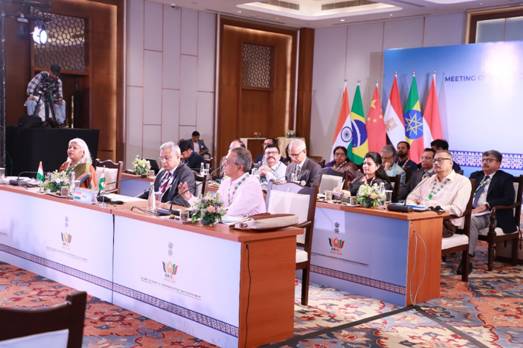
The two-day meeting of Heads of National Statistical Offices (NSO) of BRICS Member Countries was concluded on 4th August 2026, at Lucknow, Uttar Pradesh, India under the theme “Quality Statistics as a Driver of Change” aligned with the overarching BRICS theme, “Building for Resilience, Innovation, Cooperation and Sustainability”. The event brought together more than 350 participants including representatives from National Statistical Offices of BRICS, policy makers, academia, think-tanks, civil society organisation and technical experts.
During the 2nd day, the main technical Session-III on ‘Identifying Common Innovation Areas for Potential BRICS Collaboration’ included two presentations on the theme of Modern Survey Methods & Digital Data Collection were made. India and Egypt shared their experiences in using digital platforms for collection of survey and census data. India presented the experience and lessons learnt during the shift from Paper based survey to modern survey tools like e-SIGMA (e-Survey Information Gathering and Management Application) that is a Computer Assisted Personal Interview (CAPI) enabled platform, designed to integrate large-scale sample surveys into a cloud-based architecture. Egypt highlighted the use of geospatial technology in producing their official statistics. The importance of use of AI in survey implementations and more use of administrative data in a nuanced manner in conjunction with survey data was also emphasised.
Technical Session IV focused on strengthening macroeconomic and sectoral statistics, highlighting key strategies and progress made by BRICS member countries in strengthening macro-economic statistics. India presented its transition roadmap for implementing the System of National Accounts, 2025 (2025 SNA) and demonstrated effective use of administrative data in official statistics. China shared its progress and early practical experiences in introducing the 2025 SNA framework. Meanwhile, Brazil showcased the integration of alternative data sources particularly publicly available online data from expanding e-commerce and intermediary platforms emphasizing that non-traditional data can complement existing sources to significantly enhance quality of statistics produced by member countries in a rapidly changing technological landscape. Indonesia also presented its implementation plan to transition to 2025 SNA while also highlighting the adoption of ISIC 5 by them.
Along side the Meeting of Heads of National Statistical Offices of BRICS Countries 2026, the Ministry, in collaboration with the Janaagraha Centre for Citizenship and Democracy, organized the side event titled “Building AI-Ready Public Data Systems in the Evolving Data Ecosystem”. The discussions emphasized the importance of interoperable, trusted, and high-quality public data systems in enabling responsible AI adoption and supporting evidence-based governance. This side event featured a moderated roundtable discussion on the practical building blocks for AI-ready public data systems, followed by country case studies from India, South Africa, Russia, Indonesia, China, the UAE, and other partner organizations. Participants shared experiences on strengthening data governance, interoperability, metadata standards, institutional collaboration, and capacity building to transform fragmented data systems into AI-ready ecosystems. The deliberations highlighted the importance of international cooperation, knowledge exchange, and the adoption of best practices to build resilient public data systems that can effectively harness the potential of artificial intelligence for public good.
On the sidelines of the Meeting of Heads of National Statistical Offices (NSOs), the Ministry of Statistics and Programme Implementation (MoSPI), Government of India, and BPS–Statistics Indonesia signed a Letter of Intent (LoI) during a bilateral meeting to strengthen cooperation in official statistics, capacity building, and strategic collaboration. The LoI provides a framework for collaboration in areas such as knowledge exchange, technological and methodological advancement, human resource development, and emerging areas including AI, metadata standardization, and open data.
The session concluded with adoption of the BRICS Joint Statement followed by concluding remarks session. The formal adoption of the Joint Statement marks a significant milestone in strengthening statistical frameworks across BRICS member countries, laying the groundwork for more robust, transparent, and policy-relevant official statistics. The Joint Statement may be accessed at